



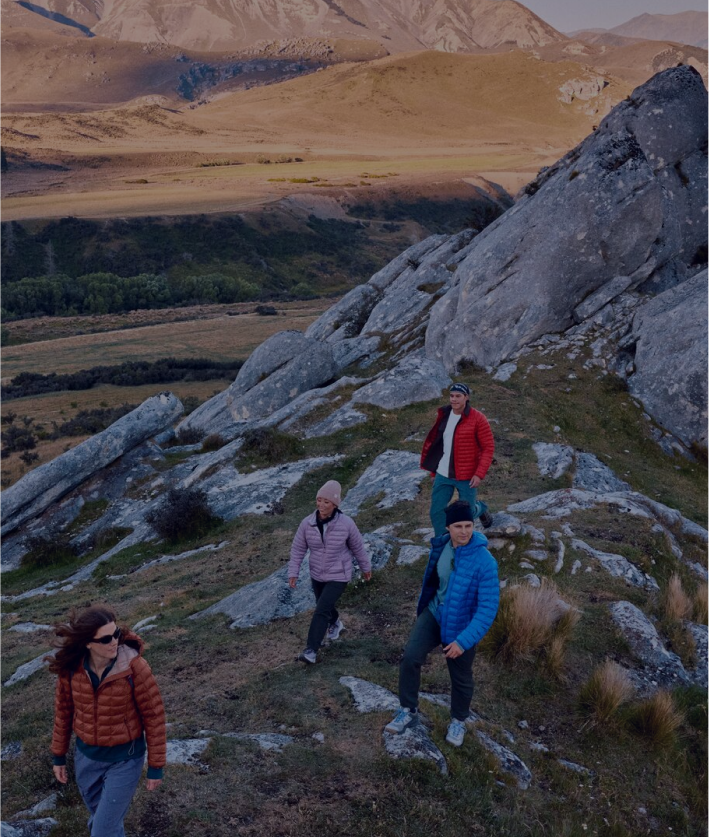
What experts actually look for when testing technical gear

When experienced hikers test gear, they’re not just looking at features.
They're asking harder questions. How does this feel at hour six? What happens when the weather turns and I need to move fast? Does this system simplify my day or complicate it?
With the XT Series, testing didn’t happen in one place. It was worn across New Zealand’s exposed alpine terrain, on multi-day hikes through Tasmania, and in Australia’s rough backcountry where scrub and rock quickly put materials under pressure. It was also tested on 24‑hour adventure races, where you’re moving for hours and don’t have the energy to keep adjusting layers.
What experts tested for:
Weight and Packability
Weight isn’t just about what you feel when you pick something up, it’s about how it carries across a full day or multi-day trip.
Across testing, the focus naturally shifted from individual pieces to the entire system as a whole. As Mowser described it, “the whole system is dialled in for fast and light.”
Packability matters too. Layers need to compress reliably, sit cleanly in a pack and be there when conditions change, not buried at the bottom when you need them most. Feedback consistently pointed to how easily layers could be added or removed without overloading a pack.
Layering
On the move, layering is a decision you make in real time, often when you’re already too hot or too cold. The clearest takeaway from testing was how naturally the XT pieces worked together. Mowser noted that “you can move through layers depending on conditions without anything feeling redundant or fighting each other.”
Comfort and movement
Over time, comfort stops being about how something feels in the store. It becomes about how gear moves with you, through climbs, descents, scrambles and the hours in between.
Across testing, this showed up in:
• Reduced bulk when layering
• Freedom of movement on climbs and descents
• Gear that stayed comfortable over extended use
Gemma McCaw described it as balance, “technical performance, comfort and lightweight design” working together rather than competing.
Breathability
At higher altitudes, breathability stops being a nice-to-have.
The Hybrid Octa Fleece stood out here, for maintaining warmth while allowing heat and moisture to escape during sustained movement. When stopping to adjust isn't practical and your body temperature keeps climbing, that's the layer doing exactly what it should.
Durability
Lightweight gear earns nothing if it doesn't last.
Testers looked closely at how materials performed in high-wear areas, where packs sit and where movement repeats.
For Ella Garbett, that practicality was clear straight away. She noted that “being able to move through rough scrub without worrying about tearing the fabric makes it far more practical for real-world trail conditions.”
Cordura reinforcement and material placement played a key role here, giving durability where it’s needed without adding unnecessary weight.
Are there trade-offs with lightweight gear?
The approach with XT was never about removing weight at any cost. It was about reducing weight where possible and reinforcing where it matters.
That balance showed up in how testers described the system as a whole - lightweight, but not delicate.
What stood out
The XT Series wasn’t tested in one place, and it wasn’t designed for one either.
From New Zealand's exposed alpine terrain to Tasmania's remote multi-day wilderness and Australia's unforgiving backcountry scrub, the same thing kept coming back. A system that adapts as conditions change and keeps performing long after the easy part of the day is over.
Explore the XT Series
-
XT Series Octa Fleece Base Layers
 |
 |
Related Articles

How to choose sun protection clothing: The ultimate UPF 50+ buyer’s guide
5 minute read

How to choose hiking pants
5 minute read

How to dress your kids for a day hike
3 minute read

Hiking Boots vs Shoes: Which should you choose?
5 minute read
How to choose sun protection clothing: The ultimate UPF 50+ buyer’s guide
5 minute read
How to choose hiking pants
5 minute read
How to dress your kids for a day hike
3 minute read
Hiking Boots vs Shoes: Which should you choose?
5 minute read